Very complicated matters, made very simple — and provable.
Ipso is a discipline before it is software. These are the rules every package obeys, the words every finding ends in, and the grades every number carries. They are what a dashboard cannot copy without becoming something else.
Start from the owner’s question
Every package begins with the question the person paying would ask, in their words — not with the data that happens to exist.
Agree the data contract
Seven sheets say exactly what feeds each view. A view whose data is missing does not guess; it says what is missing.
Keep the smallest set of true numbers
Rates, capacities and times — parameters, never totals. A whole operation is usually a few dozen numbers.
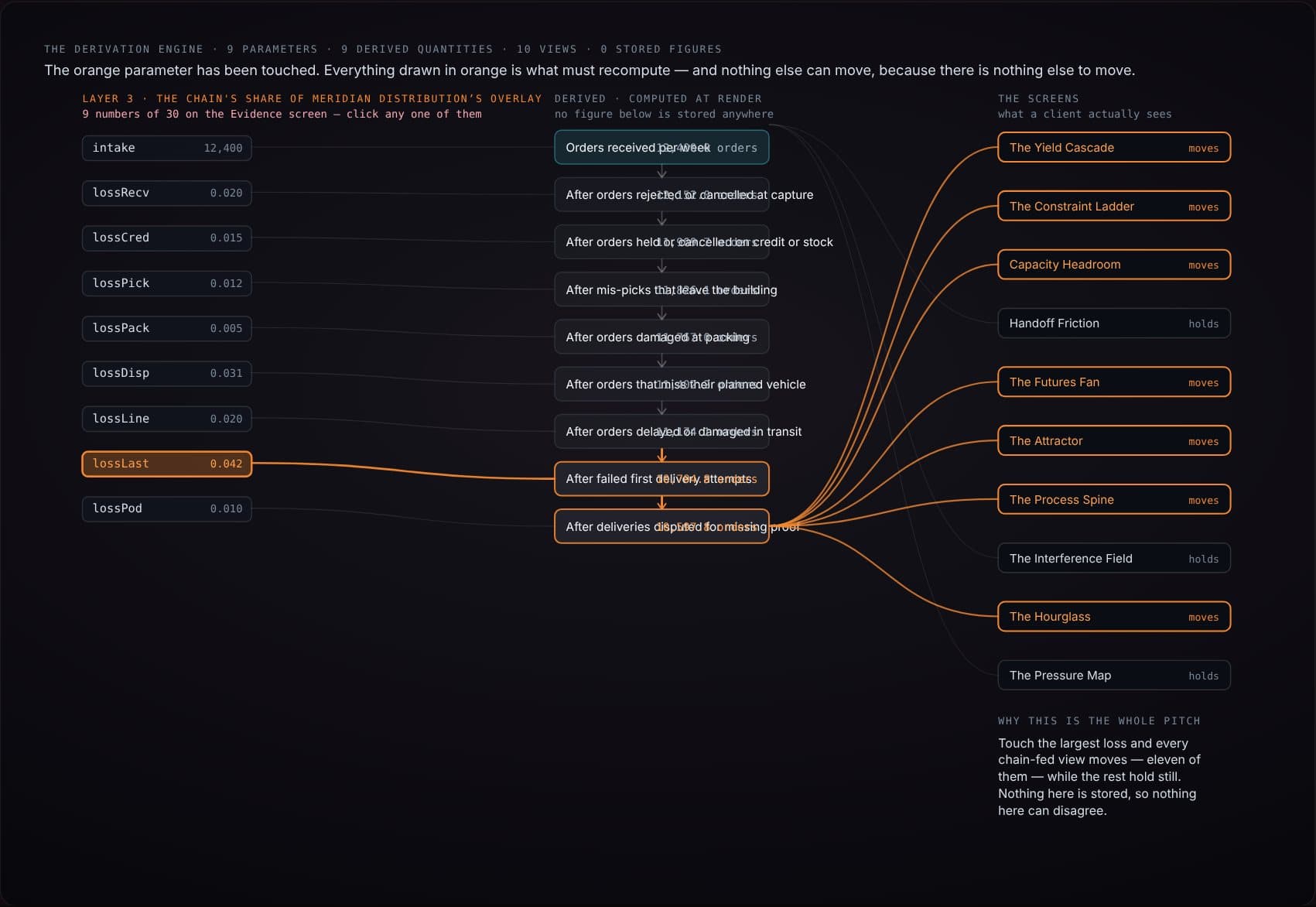
Derive, never store
Every figure is computed from the parameters at the moment you look, and every view prints a balance line that reconciles to zero.
Break it before you believe it
Disagreements between documents, systems and people are logged, never silently fixed. The disagreement log is part of what you buy.
End in a verb
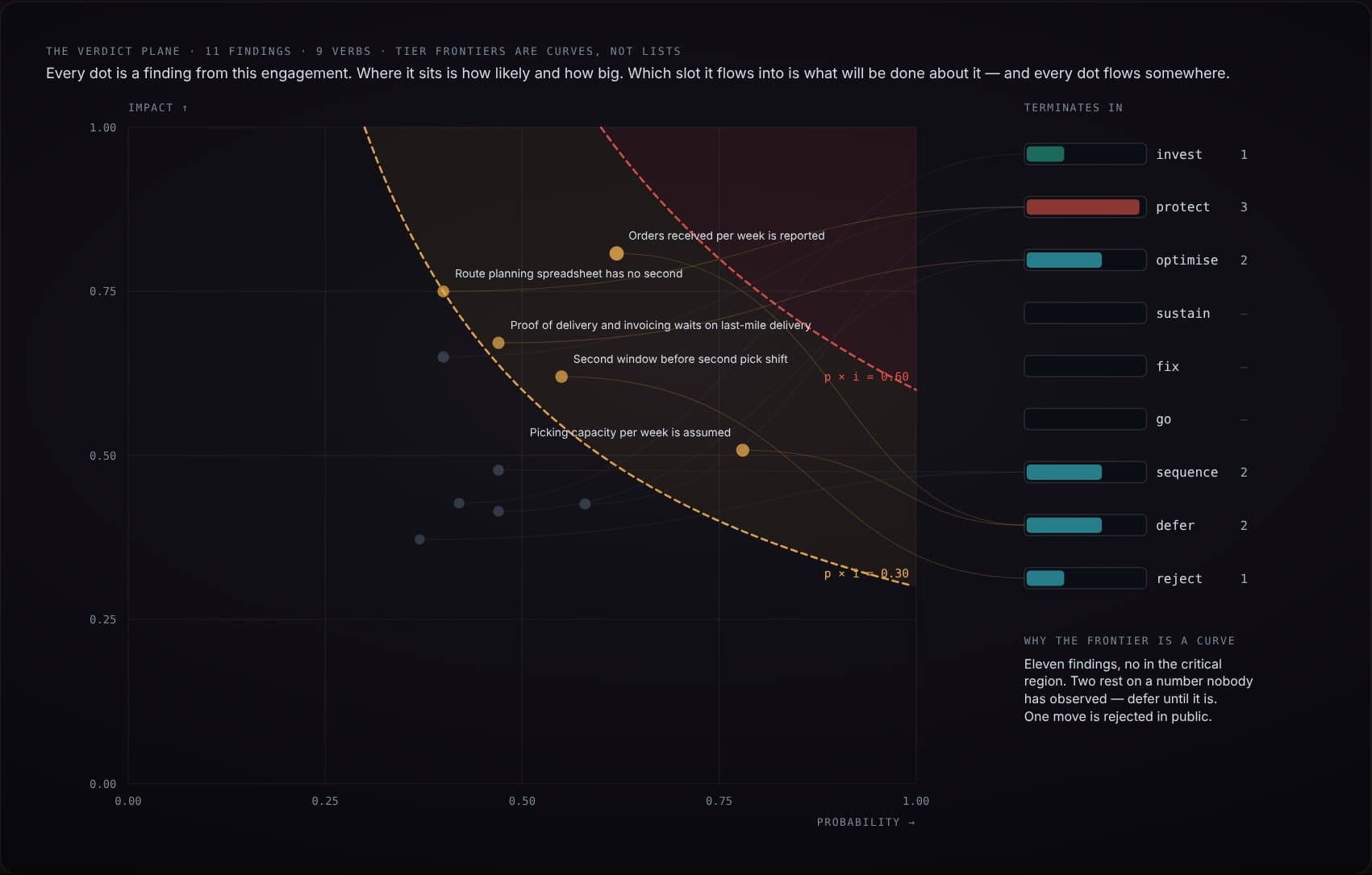
A view that ends in a number is unfinished. Every analysis terminates in one of nine decisions, with its reason written in a sentence.
Every analysis ends in a decision.
Tiers are absolute — a finding is critical at probability × impact of 0.60 and strong at 0.30, the same in every industry — never a ranking. A near-certain nuisance and an unlikely catastrophe can earn the same attention, which is why the frontier is a curve.
| invest | put new capacity or capability in |
| protect | defend something that is already working |
| optimise | tune what exists, without new spend |
| sustain | keep doing this — deliberately, on the record |
| fix | repair a defect, with a named owner |
| go | proceed — the case is proven on screen |
| sequence | order the work; the order is the finding |
| defer | do nothing yet, on purpose |
| reject | decline the option, and say why |
| observed | entered on the Evidence screen with who saw it, how and when |
| measured | taken from a system of record by a Sprint |
| documented | written in a document the business owns |
| reported | someone reported it from a report or a system |
| assumed | said in a conversation; in no document |
| placeholder | a starting value nobody has claimed yet |
Every number says how sure it is.
A sketch is honest about being a sketch: every number in it is a placeholder or an assumption, and says so on every view that uses it. A Sprint turns them into documents and measurements; Ipso Live records observations with who saw them, how and when. The package re-derives with every one.
Nine instruments that teach the method on your own numbers.
Each dramatises one law of the method, run on your parameters — so the lesson is about your business, not a textbook.
The derivation engine
TrustWe keep only a few true numbers. Every other number is made from them, so no number can lie.
The verdict plane
DecisionEvery problem gets a spot on a map, and the spot tells you which word to act on.
The futures fan
ForecastOne machine makes all the maybe-tomorrows. Flip the switches and watch tomorrow change.
The attractor
StrategyLeft alone, a ball rolls to the bottom of the bowl. Your business has a bottom too. We move the bowl.
The process spine
TimeThe work is the bones. The waiting lives between the bones — and too much waiting bends your back.
The interference field
RhythmYour busy weeks happen when your drumbeats land together. Move one drumbeat.
The hourglass
ConstraintThe neck decides what comes out. Pouring in more sand only makes a bigger pile.
The pressure map
AdjacencyTrouble makes weather. Two storms standing next to each other are really one storm.
The counterweight
ConservationHang all the work on a hanging toy. If the plan were true, it would hang level.
The engine, the industry, and your numbers.
The engine is the same in every industry: the thresholds, the verbs, the arithmetic of balance. The industry pack is the shape of the work — the stages, the losses, the limits. Your layer is only your parameters. That separation is why a sketch can be built in an afternoon, and why a re-snap re-derives the whole package from new numbers instead of rebuilding it.
See it on a sample